A First Indoor Club Night: A Plan for Arriving and Joining In
A first indoor club night feels easier with a clear plan: check the format, meet someone at the door, and choose when to watch or join.
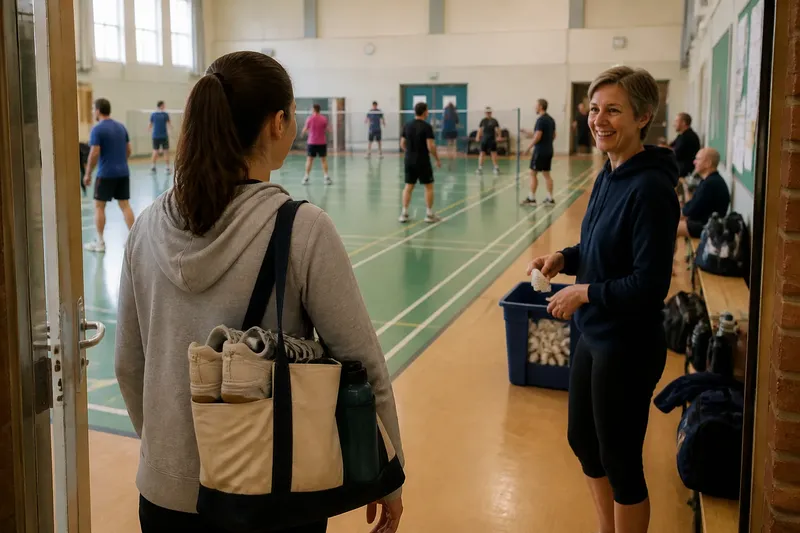
At 6:40 on a damp Tuesday, Mara parks beside the village hall with her badminton shoes in a tote bag and one question on her mind: what happens when she walks in? A first indoor club night can feel like an audition from the car park, even when the club sees it as an ordinary evening. A little preparation gives Mara a way to arrive, get her bearings and decide whether to join in without having to pretend she already knows the routine.
Imagine Mara is new to the area and has found a badminton club through a notice at the village shop. She can play casually, but she has never attended this club. Her plan is not to master the room or impress anyone. It is to learn how the session works, introduce herself to one person and make a comfortable choice about playing. That modest aim keeps the evening manageable—and gives her something useful to take away even if she mostly watches.
What should Mara check before setting out?
Indoor clubs can use the same hall for very different sessions. One night might be open play with players rotating between courts; another might be coaching, a league fixture or a booked group session. Mara sends a short message to the contact named on the notice: “I’m new and thinking of coming Tuesday. Is it open to beginners, and should I bring anything besides indoor shoes?”
That question does several jobs without demanding a special welcome. It tells the club she is a newcomer, checks that the session suits her, and gives someone a chance to explain the local arrangement. If no one replies, Mara can decide whether to call, ask at the village shop or choose a session explicitly described as open to visitors. She need not assume that silence means she is unwelcome; club volunteers may be working or away from messages.
She checks the practical details that could otherwise distract her at the door:
- Session type: Is it social play, coaching, a team practice or a match night?
- Arrival routine: Should newcomers come at the start, or is there a usual person to ask for?
- Equipment: Does she need a racket, shuttlecocks or anything the club supplies?
- Clothing and footwear: Are clean, non-marking indoor shoes expected?
- Payment and booking: Is there a visitor fee, a sign-up arrangement or a limit on drop-ins?
- Changing space: Is there somewhere to change, or is it simpler to arrive ready?
Where an item depends on the venue’s rules, the club’s instructions or the equipment maker’s label, Mara follows that guidance rather than guessing. She puts her shoes and a water bottle in her bag and leaves her racket at home until she learns whether the club has spares. The point is not to pack for every possibility. It is to avoid a preventable snag and keep the first visit simple.
How can she make the doorway feel less awkward?
Mara arrives a few minutes before the advertised start, not so early that the hall is empty and not so late that everyone is already playing. She hears the thump of a shuttlecock before she opens the door. Inside, people are putting bags against the wall and chatting between courts. She pauses just inside, makes eye contact with the person near the equipment basket and says, “Hi, I’m Mara. It’s my first time here. Who should I check in with?”
That is enough. She does not need a polished introduction, a story about her playing history or an apology for being new. A name and a clear question give someone an easy way to help. If the first person is busy, she can wait at the edge of the room and ask another club member rather than trying to interrupt a rally.
It helps to have one follow-up ready: “Is there a place beginners usually start?” or “Would you mind showing me how players take turns?” These questions invite practical answers. If the club has a desk, attendance sheet or regular greeter, Mara can follow that routine; if not, she has already made the important connection by letting someone know she has arrived.
She also gives herself permission to take a moment. Finding a place for her bag, noticing where people leave outdoor shoes and locating the water fountain are ordinary first-night tasks, not signs that she is failing to fit in. In a rural club, one person may be welcoming visitors while also setting up nets or sorting out the evening’s courts. A brief pause can give that person time to finish what is in their hands.
When should she watch, and when should she join?
Once Mara has said hello, she watches a game from the side for a short while. She is not trying to track every score or learn every club habit at once. She looks for the simple pattern: who is waiting, how players rotate, whether people call their own lines, and where someone goes when a court becomes free. Those clues can make the first invitation easier to understand.
A member asks whether she would like to hit a few shots. Mara says, “I’d be happy to try, but I’m rusty. Is there a relaxed court?” The answer is a quick warm-up with two other players who are also there for social play. That suits her better than stepping into a close game where she would be unsure about the pace and local etiquette.
She can treat joining as a choice rather than a test. If she feels ready, she can accept one game and ask about the scoring or rotation before it starts. If she wants to watch longer, she can say so plainly: “I’d like to see how the games run first, then I may join the next one.” A good club night should leave room for that kind of straightforward answer.
When she does play, Mara pays attention to the immediate basics: where to stand, when a point begins and how the group handles turns. She asks when she is unsure instead of making a guess that could confuse the next game. Nobody expects a newcomer to know a club’s private shorthand. A quick “Do we switch after this game?” is easier for everyone than silently trying to infer the rule.
Say Mara reaches the hall and discovers that the social court is full, while a faster group is about to start. She watches one game, then asks the person near the court whether there is another beginner-friendly group or a better time to return. The likely result is a clear choice: wait for a suitable opening, take a break, or come to a different session. Even if she does not play that night, she has learned who to contact and what kind of evening to expect.
What questions might she want answered?
Does Mara need to be good before she turns up?
No. She needs to check that the session welcomes her experience level, then describe her comfort honestly when someone asks her to play. A club can help place her in a suitable group more easily when she says whether she is a beginner, returning after a break or simply there to play socially.
What if she arrives and does not recognize anyone?
She can introduce herself to the first available person near the entrance, courts or equipment area and ask who is organizing the session. If everyone appears occupied, waiting at the side until a pause is usually more considerate than stepping onto a court or interrupting a point.
Is it rude to watch before joining?
Not if she stays clear of play and tells someone she is getting familiar with the routine. Watching can help her understand rotations and the session’s pace, while a simple comment such as “I’ll join when there’s a relaxed game” makes her intention clear.
What should she say if she wants to leave early?
She can thank the person who welcomed her and say she is heading off, without inventing an excuse. If she has enjoyed the visit, asking when the next suitable session is gives her a natural way to leave with a practical next step.
What does Mara take away from the evening?
Mara plays one game, watches another and leaves before the hall closes. The result is not a sudden sense that she belongs to every corner of the club; it is a more useful kind of progress. She knows who to greet next time, where the spare rackets are, how players rotate and which part of the session feels comfortable. She also knows what to ask before returning.
On the way home, she sends a brief message to the club contact: “Thanks for welcoming me. I enjoyed the social game and will try to come back next Tuesday.” If the evening was not a fit, she could instead thank them and ask whether another session is more relaxed. Either message closes the loop politely and helps the club understand what she is looking for.
A first indoor club night works best when the newcomer keeps the goal small and the choices open. Check the format, arrive with a simple introduction, observe enough to understand the flow, and join when the invitation and the pace feel right. For Mara, the useful measure of a first visit is not how many games she played. It is whether she leaves knowing what her next comfortable move could be.