Club Rota or Open Sign-Up? Sharing Match-Day Jobs
Club rota or open sign-up? Choose a fair way to assign match-day jobs, clarify ownership and keep ordinary tasks from slipping through the cracks.
Club rota or open sign-up? If the tea urn is empty and nobody knows who was meant to bring the cups, the problem is usually not a lack of goodwill. It is that a match-day job was never clearly assigned. Rural clubs often rely on familiar faces and informal messages, but even a small fixture needs someone to take ownership of ordinary tasks.
A rota gives each person or household a turn; open sign-up lets volunteers choose from a shared list. Neither works by itself in every club. The useful question is what goes wrong in your current arrangement, and what small change would make the next fixture clearer.
Why does a job disappear between the list and match day?
A name beside a task can look like an assignment without being one. Perhaps the club secretary added “tea” to a WhatsApp message, or a parent said they could “probably help.” If nobody confirms who is bringing the milk, setting out mugs, and switching on the urn, each person may assume someone else has it covered.
Try writing each task as a clear responsibility, not a vague category. “Set up refreshments” may mean several things; “bring milk and cups” is easier to accept or decline. For jobs with separate parts, name a lead person and list the pieces they are coordinating.
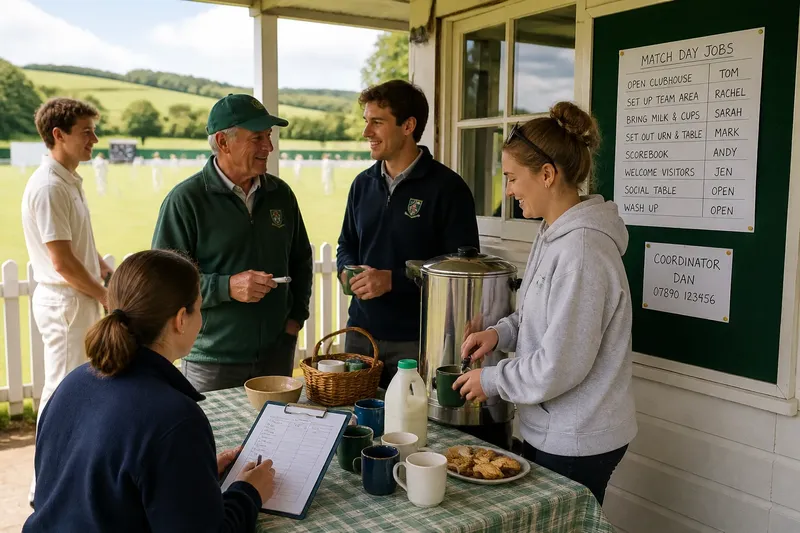
Say a small village cricket club expects a home fixture on Saturday, and the usual volunteer is away. The club’s invented scenario has a shared list showing “tea” but no name. The coordinator could split it into “bring milk and cups” and “set out the urn and table,” then ask two people to claim those exact jobs. The expected observable result is that each person can say what they are responsible for before match day, rather than discovering a gap at the pavilion.
When does open sign-up leave the same people doing everything?
Open sign-up feels flexible, especially when players’ work shifts, family commitments, and travel vary from week to week. But if the list goes out late or the task is unappealing, the quickest responders may take the easiest jobs while less visible duties remain unclaimed. Over time, a handful of reliable helpers can become the default crew without anyone choosing that arrangement.
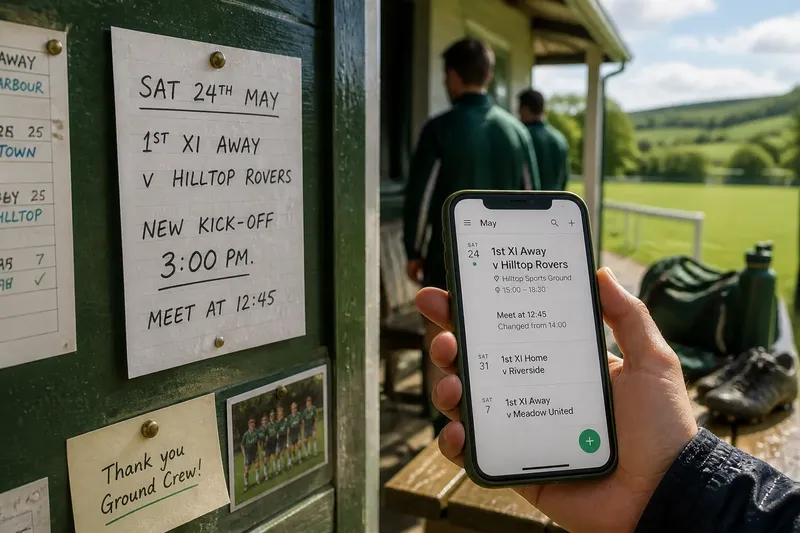
Make the choices visible early and show which jobs still need a volunteer. A paper sheet in the clubhouse can work alongside a pinned message in WhatsApp; use the channel members actually check. Give each task a named slot and a simple way to say “I can do this.” If a job remains open, ask directly rather than treating silence as consent.
Open sign-up is a good fit when the group is large enough to respond and tasks are straightforward to choose. It can also suit fixtures with changing attendance. It is less reliable when the club has a small pool of helpers or when one essential job is easy to overlook. In those cases, a rota or a named backup can protect the basics without removing choice from every other task.
How can a rota feel fair without becoming rigid?
A fixed rota can make responsibility visible and prevent the same person from being asked every week. Yet a schedule that ignores real availability can feel like a penalty. A family may be assigned a task on the weekend they are away, or a player may be expected to help immediately after a long journey.
Use the rota as a prompt for arranging cover, not as a rule that people must silently endure. Share upcoming turns in a place members can find, and let people swap directly or ask the coordinator to help find a replacement. Keep the change visible so the person opening the clubhouse is not relying on an outdated sheet.
Rotate by people, households, or small groups according to how your club organizes itself. Avoid assuming that everyone has the same time, mobility, transport, or confidence with a task. A member who cannot carry equipment might still welcome a job greeting visiting teams or keeping the scorebook tidy. Fairness is clearer when people can discuss a suitable contribution rather than being assigned an identical burden.
What if nobody knows who owns the last-minute change?
Rain, a delayed start, or a late fixture change can disrupt the plan. The trouble often begins when a message says “Can someone sort the pavilion?” without identifying who will decide, tell others, or confirm the task is done. Several people may respond with suggestions while nobody takes responsibility for the next action.
Name one match-day coordinator for each fixture, even if that person is not doing every job. Their role is to notice unclaimed tasks, confirm changes, and pass information to the right helpers. This does not mean they must carry every burden; it means the club has a clear contact when plans shift.
Keep the update brief and specific: say what changed, which task is affected, and who is taking it. If the coordinator cannot attend, agree on a substitute before the fixture. Where a task depends on equipment instructions, venue arrangements, or local requirements, follow the relevant guidance and ask the appropriate person rather than improvising.
Which arrangement suits your club’s match-day jobs?
Choose the format by the kind of task and the people available, not by a general preference for structure or spontaneity.
- Use a rota for recurring jobs that must be covered every fixture, such as opening the clubhouse or preparing the team area.
- Use open sign-up for optional or easily shared jobs, such as bringing baking or helping with a social table.
- Use a mixed system when one essential task needs a named turn but other contributions can remain voluntary.
- Ask people privately if public sign-up tends to favor the most confident voices or leaves newer members unsure whether they may volunteer.
- Keep a backup contact for tasks that cannot simply be left until the next fixture.
Whichever system you choose, record the person who accepted the task, the task itself, and any agreed cover. A shared spreadsheet, a clubhouse noticeboard, or a pinned group message can do the job; the important part is that members know where the current version lives.
What do club members ask about sharing match-day jobs?
Should every match-day job have one named person?
Every essential job should have a clear owner, though that person can coordinate a small team. Optional tasks can stay open for volunteers as long as no one mistakes an empty slot for a confirmed arrangement.
How often should a club update its rota?
Review it when people’s availability changes or the club notices a recurring gap. A quick check before a new run of fixtures can catch outdated assignments without making every match an administrative exercise.
What should we do when nobody volunteers?
Contact members directly, explain the task plainly, and ask whether they can take it or suggest a workable alternative. If the job is essential and no one is available, the coordinator should raise the gap with the club rather than quietly assuming it will be covered.
Can a rota and open sign-up work together?
Yes: reserve a rota for recurring essentials and offer open sign-up for flexible extras. That arrangement gives members choice where it helps while keeping basic match-day responsibilities explicit.
How do you know the arrangement is working?
Look for ordinary signs: helpers know what they have agreed to do, swaps are visible, and the same person is not repeatedly surprised by an unclaimed task. If a job still falls through, ask whether its description was clear, whether the timing suited volunteers, and whether someone had authority to coordinate a change.
Club rota or open sign-up is not a permanent verdict on how your club should operate. Start with the one task that most often causes confusion, make its owner and cover clear, and review the arrangement after a few fixtures. A modest, visible system lets people offer help without asking them to guess what the club needs.